August Sky Spotlight

Astronomy and Physics, Earth, News

2nd: Moon at Perigee

On August 2nd, the Moon will be at its closest spot to Earth. This is called perigee.

7th: 1st Quarter

The Moon will be in its first quarter phase!

9th: Moon and Jupiter; Mercury in Greatest Western Elongation

The Moon and Jupiter will meet in the constellation Scorpio in the Southwestern sky.

Saturn, Venus, and Mercury in a dawning sky. Source: universetoday.com

Since Mercury is in between the Earth and the Sun, Mercury is always in the daytime sky. As Mercury goes around the Sun, it gets closer and farther away from the Sun in the sky. On the 9th, Mercury will be as far from the Sun as it gets. This is called greatest western elongation. This is when Mercury is at its best viewing because it’s not washed out by the Sun.

11th: Venus and Sun

On the 11th, Venus and the Sun will be together in the constellation Cancer! However, the Sun’s brightness will make this nearly impossible to view. Look towards (but not at) the rising Sun in the East.

12th: Moon, Saturn, and Pluto; Perseid’s Peak

The Moon, Saturn, and Pluto will be together in Sagittarius on the 12th. To see them, look towards the Southern sky.

In addition to seeing the Moon and planets, this night will feature one of the best shows the sky puts on: a meteor shower. The Perseid Meteor Shower will peak the night of the 12th and into the morning of the 13th. Look to the Northeast to see the show. Unfortunately, the bright Moon will inhibit viewing, but there will still be plenty to see!

15th: Full Moon, Venus at its Brightest 

The 15th will bring a full moon! And, if you look at the dawn sky, you will see a very bright Venus.

17th: Moon and Neptune; Moon at Apogee

The Moon and Neptune will appear together on the Eastern side of Aquarius. In addition, the Moon will be at apogee, it’s farthest point from Earth.

21st: Uranus and Moon

On the 21st, Uranus and the Moon will be seen in the Eastern sky in Aries.

23rd: Last Quarter; Venus and Mars

The Moon will be in its last quarter phase on the 23rd, while Venus and Mars will be together in the sky. They will be near the Sun in the constellation Leo.

29th: Mercury, Moon, and Sun

On the 29th, Mercury, the Moon, and the Sun will all be together. Look to the dawn sky to see them.

30th: Moon, Venus, and Mars; New Moon; Moon at Perigee 

The Moon, Venus, and Mars will be near the Sun; dawn will bring the best viewing. However, the new moon may be difficult to spot. Finally, the Moon will have returned to its closest point to the Earth.

31st: Sun and Mars

The Sun and Mars will be together in the constellation Leo.


July Sky Spotlight

Astronomy and Physics, Earth, News

2nd – New Moon, Total Solar Eclipse

July will start off as strong as June did! On only the second day of the month, we will have a total solar eclipse. Most of South America will be able to see at least a partial eclipse. Check Time and Date to see if you’re in the path!

3rd – Moon with Mars and Mercury

Astronomers call the sliver after a new moon a young moon. July’s young moon will be hanging out with Mars and Mercury in the constellation Cancer.

4th – Earth at Aphelion

The Earth’s orbit around the Sun is not a perfect circle, it’s an ellipse. This means that at some point, it must be at it’s furthest point from the Sun. That is in July! Aphelion is when a planet is farthest from it’s sun. This won’t affect our life at all, it’s just a neat fact.

9th – First Quarter, Saturn at Opposition

On July 9th, the Moon will be in it’s first quarter phase. This means that the left half will be dark and the right half will be light.

In addition, Saturn will be at opposition. This means that Earth will be directly between Saturn and the Sun.

13th – Moon with Jupiter

Jupiter and the Moon will be together in the constellation Scorpius in the Southern sky.

15th – Moon with Saturn

Saturn will be just East of the nearly full moon. They will be together in the constellation Sagittarius in the Southern Sky.

16th – Full Moon, Partial Lunar Eclipse

Most of the world (not including North America) will be able to see the Partial Lunar Eclipse! Check Time and Date to see if you’re in the path. If, like me, you are not in the path, enjoy the bright, beautiful full moon.

20th – Moon with Neptune

The Moon will be with Neptune in the constellation Aquarius in the Eastern night sky.

24th – Last Quarter, Moon and Uranus

On the 24th, the Moon will be in it’s last quarter with Uranus. They will be in Aries.

28th – Southern Delta Aquariid Meteor Shower Peaks

From midnight to dawn, and especially at 2 a.m., we will be able to see meteors originating from Aquarius. The moon will be a dark crescent, so the meteors will be easier to see. It is more visible from the Southern hemisphere than from the Northern Hemisphere.

31st – New Moon

Finally, on the last day of the month, we will end the same way we began: with a new moon.

Happy July viewing!


June Sky Spotlight

Astronomy and Physics, Earth, News

June is finally here! There’s a lot of exciting sights in the sky this month. Unfortunately, Mars and Venus will not be in their best viewing location; both planets rise in the morning and set in the afternoon and evening. Luckily, however, Jupiter and Saturn will be quite visible! These planets will rise in the evening and set in the morning.

June 2nd: Solar Eclipse

On June 2nd, there will be a solar eclipse that will be able to be seen from parts of the Southern Hemisphere! You can search Time and Date’s path map to see if you’ll be able to view it!

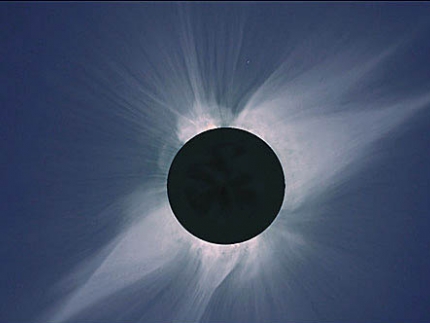
Total solar eclipse. The Sun’s cornea is only visible from Earth during a solar eclipse. Source: NASA

A solar eclipse occurs when the Moon is in between the Sun and the Earth. The Moon’s orbit is tilted around the Earth, so every new moon doesn’t produce an eclipse. Totality (when the Moon completely covers the Sun) will occur at 19:22:57 UTC.

June 3rd: New Moon

New month, new moon! New moon is the first phase of the Moon. When the Moon is in its new moon phase, it can’t be seen very well. In addition, we will experience a spring tide, meaning the high tides will be extra high, while the low tides are extra low. The Moon will be near the Sun in the constellation Taurus.

June 10th: First Quarter and Jupiter Closest Approach

First Quarter is when the right half of the Moon is lit up, while the left side is shrouded in darkness. The Moon will be on the western edge of Virgo. First Quarter also brings a neap tide. A neap tide is when the difference between the high and low tides is at a minimum.

Also on June 10th, Jupiter will be as close to Earth as it gets for a while. It will appear bigger and brighter! Furthermore, Jupiter will be directly opposite the Sun. Jupiter will be in between Scorpius and Sagittarius in the eastern sky.

June 16th: Moon and Jupiter Together

On June 16th, a nearly-full Moon and Jupiter will be together in the sky. They will be in between Scorpius and Sagittarius in the eastern sky.

June 17th: Full Moon

The full moon will be right above Sagittarius in the east. A full moon is when the side of the Moon facing us is totally lit by the Sun. The June full moon is known as the Strawberry Moon. They call it the that because June is the start of strawberry season. There will be another spring tide.

June 18th: Moon and Saturn Together

If you look to Sagittarius in the east on June 18th, you will see the Moon and Saturn together in the sky. Saturn will be directly above the bright moon, so it may be difficult to spot.

June 21st: Summer Solstice

June 21st is the Summer Solstice! The summer solstice is the longest day of the year in the Northern Hemisphere, and the shortest in the Southern. This is due to the axial tilt of the Earth.

June 23rd: Moon at Apogee

On June 23rd, the Moon will be at apogee. Apogee is when the moon is farthest from the Earth. The Moon’s orbit is elliptical enough to create a noticeable difference between apogee and perigee (when it’s closest to the Earth). You can see the tiny moon if you look to Aquarius.

Source: Muzamir Mazlan at Telok Kemang Observatory, Port Dickson, Malaysia.

June 25th: Last Quarter

The moon will be in last quarter on June 25th. The last quarter is when the left side of the moon is lit, while the right is completely dark. The last quarter will be in the constellation Pisces. There will be another neap tide.


Illu-moon-ating Research

Astronomy and Physics, Earth, News

In 2020, NASA will be launching the Space Launch System’s first Exploration Mission. On board will be yeast (to study radiation in space), a solar sail (that will study a near-Earth asteroid), and something called Lunar Flashlight.

Many craters on the Moon are constantly shrouded in shadows. This is a huge problem because light is the only thing we receive from space that we can study (besides meteorites and, of course, going there). Since we don’t receive light from these craters, we have absolutely no idea what’s down there.

That’s exactly what Lunar Flashlight hopes to illuminate.

In the past, the only way to study shadowed craters was to slam something into them and study the debris that flies up. This method allowed scientists to study only one location at a time. Now, the whole Moon can be observed from orbit. Lunar Flashlight will use a solar sail to reflect light into these dark craters. Then, scientists will study the light reflected back and make a map of where the water ice is located.

Artist concept of Lunar Flashlight. Source: NASA/JPL-CalTech

We’ve known about water on the Moon since 2009 when NASA’s LCROSS probe slammed into the Moon’s south pole. Then, in 2017, researhers from Brown University made a map of water on the Moon. However, they acknowledge “that only a small fraction of the Moon has been directly sampled.” Lunar Flashlight hopes to fill in those gaps.

When we go back to the Moon, we want to do so in a strategic location. According to NASA, “resources at destinations in space, such as atmospheres, water ice and regolith, can be broken down into their component molecules and used as building materials, propellant, oxygen for humans to breathe and drinking water.”

Locations with more of these resources are therefore more valuable than those without. NASA hopes to find more of these locations in places that we have been unable to study. In the future, they may be used as a landing spot or the home of a Lunar base.

Nearly 50 years ago, NASA only dreamed of going to the Moon. Now, we are planning a Lunar base to take us beyond our tiny portion of the solar system. Lunar Flashlight is just the beginning.

Saturn’s Spectacular Rings

Astronomy and Physics, solar system

Saturn’s rings are easily one of the most amazing sights in the solar system. However, most people don’t know much, if anything, about them. First, it’s important to note that Saturn is not the only planet with rings; all four gas giants have them! However, Saturn’s rings are bigger than any other planet’s. They’re big enough that they can be seen with a relatively small telescope from your own backyard!

Discovering the Rings

Galileo was the first to observe Saturn’s rings in 1610. However, he didn’t immediately realize that what he was looking at was rings. He described what he saw as “ears,” and drew a circle with a smaller circle on either side. Two years later, these “ears” disappeared completely from view. Even more confusing was when they reappeared in 1613.

Galileo’s drawing of Saturn. Top from 1610, bottom from 1616. Source: NASA

In 1655, Christiaan Huygens observed Saturn with a newer, more advanced telescope. He was the first to suggest that Galileo’s “ears” may, in fact, be a system of rings around the planet. Around the same time, Robert Hooke observed the rings and noticed shadows upon them. Then, in 1675, Giovanni Domenico Cassini (also known as Jean-Domenico Cassini) discovered a gap in the rings. Over 100 years later, in 1787, Pierre-Simon Laplace proved that a single disk would not be stable as rings, and proposed that the rings were many tiny rings. Then, over 70 years after that, in 1859, James Clerk Maxwell proved that rings had to be made of many tiny particles to be stable. Nearly 40 years later, in 1895, James Keeler of Allegheny Observatory and Aristarkh Belopolsky of Pulkovo Observatory confirmed that Maxwell was correct; the rings are made up of many tiny particles.

A Look at the Rings

There are 7 major rings around Saturn. Closest to the planet is the D ring, followed by the C ring, B ring, A ring, F ring, G ring, and finally, the E ring. The rings were named in the order they were discovered, so, unfortunately, there is nothing intuitive about this naming system. The rings are made of particles of water ice, ranging in size from .4 inches to 39 inches (1 centimeter to 10 meters). All of these bits added together are about half the size of the Earth’s Antarctic ice shelf.

The rings are roughly 180,000 miles (400,000 kilometers) wide but only 30 to 3280 feet (10 to 1000 meters) thick. The rings are so much wider than they are thick that the rings form a disk-like shape. In fact, if you were to make a scale model of Saturn’s rings in which their thickness is that of a sheet of paper, the rings would be 1.7 miles (2.7 kilometers) across.

Source: NASA/JPL-Caltech/Space Science Institute

Evidence suggests that the rings are only 100 million years old. 100 million years ago, dinosaurs were still wandering the Earth! Now, I know this seems old, but on the time scale of the solar system, that’s basically a baby! For reference, the Earth formed 4.5 billion years ago. That means that the rings formed 4.4 billion years after the Earth.

Scientists are not really sure how the rings formed, so there are a couple of different theories. Many of the theories propose that a moon may have been destroyed (whether by Saturn’s gravity or a collision with another object) and the debris formed the rings. Another theory is that the rings are just leftovers from Saturn’s formation that failed to form a moon. Saturn’s E ring, however, is formed in a totally different way. As Saturn’s moon Enceladus orbits the planet, it spews its icy innards into orbit.

Saturn’s rings are largely influenced by its moons. The Keeler Gap, a break in the A ring, is caused by Saturn’s moon Daphnis clearing its path around the planet. Prometheus and Pandora created the F ring, making them shepherd moons. A shepherd moon is a moon whose gravity forces material into a ring, like a shepherd with their sheep. There are other minor rings who have been corralled there by nearby moons.

Disappearing Rings

Every 15 years, Saturn’s rings grow thinner and thinner until finally, they disappear from view! This phenomenon is known as a ring plane crossing. Galileo was the first to observe a ring plane crossing in 1612 when the “ears” of Saturn disappeared. Like the Earth, Saturn and its rings are tilted with the Sun—27 degrees, to be exact. When the Earth and the rings line up just right, the rings are edge on to us. Since the rings are so thin, we can’t see them. The next ring plane crossing is on March 23, 2025, but Saturn will be close to the Sun and therefore difficult to view.  

Left: Source: NASA and The Hubble Heritage Team (STScI/AURA)Acknowledgment: R.G. French (Wellesley College), J. Cuzzi (NASA/Ames), L. Dones (SwRI), and J. Lissauer (NASA/Ames). Right: Saturn with two of it’s moons, only visible during a ring plane crossing. Source: Amanda S. Bosh (Lowell Observatory), Andrew S. Rivkin (Univ. of Arizona/LPL), the HST High Speed Photometer Instrument Team (R.C. Bless, PI), and NASA/ESA.

Ring plane crossings are very exciting for astronomers because it gives them an opportunity to view the planet without the giant, bright rings in the way. In addition, many of Saturn’s moons can only be viewed during a ring plane crossing. 13 of Saturn’s moons were discovered during ring plane crossings, while others’ orbits were able to be studied further. Furthermore, scientists can discover more rings during the crossing—that’s how they found the E ring.

One thing that scientists know for sure is that Saturn’s rings used to be bigger than they are now. They know this because the rings fall into Saturn and become what is appropriately called “ring rain.” At the rate at which the rings are decaying, they could disappear as soon as 100 million years from now.

Luckily, 100 million years is plenty of time for us humans, and we have a lot more research to do. The Cassini spacecraft was able to answer some questions for us, but not all. Saturn’s beautiful rings may not last forever—but they’ll last a lifetime. And that, my friends, is enough for me.

Best Moons in our Solar System

Astronomy and Physics, solar system

In our solar system, there are nearly 200 moons orbiting eight different planets. Of course, these moons aren’t split evenly. Mercury and Venus don’t have any moons, while Jupiter has over 70—and counting. With this many moons, it’s easy to pick favorites. So I did! Here are six of my favorite moons in the solar system.

Our moon

Left: From Bill Ingalls. Top Right: Apollo 8’s iconic Earthrise, taken by Bill Anders. Bottom Right: The moon, as viewed from Earth, with Venus to the left. From Bill Dunford. Source: NASA

Naturally, I have to start with our moon, sometimes called Luna. Our Moon has a radius of 1080 miles (1737.5 kilometers) and is 238,855 miles (384,400 kilometers) from the Earth. With roughly the same apparent size as the Sun, the moon is the brightest object in our night sky. The Moon is tidally locked with the Earth, meaning we always see the same side of the Moon. The side we don’t see is often called “the dark side of the Moon,” but this is simply not true. This side of the Moon is lit by the Sun just as often as the other side.

The Moon is the only place outside of the Earth that humans have been. Thanks to this, we know tons about the Moon. For example, we know that the Moon has no atmosphere, and therefore, no wind. In addition, we have a pretty good map of the Moon and its craters. These craters are the most prominent features on the Moon’s surface.

Mimas

Left: Taken by the Cassini spacecraft. Top Right: Saturn with Mimas, a tiny dot to the bottom left of the image. Taken by the Cassini spacecraft. Bottom Right: Taken by Voyager 1. Source: NASA/JPL

Mimas just might be my favorite moon in the solar system. Discovered orbiting Saturn by William Herschel in 1789, it’s most prominent feature is the giant crater (complete with a central peak) on the right side of the image. This crater is named Herschel, after, of course, the man who discovered the moon. In the 1980s, NASA got its first up-close images of the moon as the Voyager crafts passed by. Immediately, many Star Wars fans noticed that Mimas looks an awful lot like the Death Star! Years later, the Cassini spacecraft took more fantastic images of the moon.

Mimas is one of Saturn’s closer moons, orbiting only 115,000 miles (186,000 kilometers) from the planet. Like our moon, Mimas is tidally locked with Saturn. Mimas is slightly ovoid (meaning a little more oval than a sphere, like an egg) and has a mean radius of 123 miles (198 kilometers). In addition, Mimas seems to be made entirely of water ice.

Io

Top Left: An eruption can be seen as a blue haze on top of the planet. Taken by the Galileo spacecraft. Bottom Left: A tiny Io is dwarfed by Jupiter. Right: Io, in true color. Source: NASA/JPL/University of Arizona

In 1610, Galileo pointed his telescope towards Jupiter and noticed four little dots moving back and forth across the planet. These four dots are now known as the Galilean Moons, my favorite of which is Io. Only a little larger than our moon, Io shoots around Jupiter in less than two Earth days at a distance of 262,000 miles (422,000 kilometers). As Io speeds around Jupiter and through its electric field, the moon generates a current that sparks lightning in the planet’s upper atmosphere.

Io’s weird, dotted color (making it look a little like a moldy pizza) is due to the volcanoes that cover the moon. In fact, Io is the most volcanically active body in the solar system. Like Mimas and our moon, Io is tidally locked with Jupiter. This, along with its highly elliptical orbit, cause insane tidal forces on the moon. These forces heat up Io, causing all the volcanic activity. Io seems to be made of mostly sulfur or silicate rock. These materials would explain Io’s “moldy pizza” appearance.

Phobos and Deimos

Top Left: Phobos. Bottom Left: Deimos. Right: Mars with the two moons as seen by Curiosity. Source: NASA/JPL-Caltech/GSFC/Univ. of Arizona

Deimos and Phobos were discovered by Asaph Hall in 1877. These cratered, irregularly shaped moons are among the smallest in the solar system. Right now, it’s believed that these moons are captured asteroids, but it’s possible that this is untrue. Like many other moons, these are tidally locked with Mars.

Phobos, the larger of the two, speeds around Mars three times a day. This moon is gradually moving closer to the planet, meaning that in the future, it will either crash into Mars or break apart into rings. A prominent feature of Phobos is the giant impact crater, called Stickney. Stickney is 6 miles (9.7 kilometers) wide.

Deimos only orbits Mars once every 30 hours. Deimos appears to be so tiny that it’s gravitational pull can’t hold onto ejected material after a meteorite strikes.

Titan

Left: The first image of Titan’s surface, taken by the ESA’s Huygens probe. Top Right: Titan and Diane (another of Saturn’s moons) in front of the Planet. Taken by Cassini. Bottom Right: Titan in front of Tethys (another of Saturn’s moons). Taken by Cassini. Source: NASA/JPL/ESA/University of Arizona

Titan has a radius of 1,600 miles (2,575 kilometers) and orbits Saturn once every 16 Earth days. Titan is Saturn’s largest moon, and the only moon known to have a significant atmosphere. This atmosphere, made of nitrogen, gives Titan it’s hazy appearance. Titan rains methane and ethane onto a water ice crust. Seas, lakes, and rivers, also made of methane and ethane, flow across the surface. Beneath the crust is a sea of water.

Titan’s water interior could hold life. Even more exciting, however, is the possibility of the surface holding life. Life that formed on Titan’s surface would be chemically different from our own. That being said, there is currently no evidence of Titan containing life; more research is needed.

Europa

Top Left: Taken by the Galileo spacecraft. Bottom Left: Europa’s scratched surface, taken by the Galileo spacecraft. Right: Jupiter with Europa to the right, casting a shadow on the planet. Source NASA/JPL-Caltech/SETI Institute/ASU

Europa, another Galilean moon, is largely considered to be the best shot at life off of Earth. Europa has a diameter of 1,940 miles (3,100 kilometers) and orbits Jupiter twice every seven Earth days. Europa’s surface is made of water ice with a deep liquid water ocean underneath. This icy surface is covered with scratches and cracks due to tidal forces from Jupiter, Io, and Ganymede. These tidal forces also heat up Europa’s subsurface sea.

Like Io, Europa also has an induced magnetic field from Jupiter’s magnetic field. The fact that there is a magnetic field suggests a salt water ocean under the icy surface. We know that life could potentially form there because life has formed in similar conditions on Earth. Right now, missions are being planned by NASA and the ESA (European Space Agency) to find life on Europa.

All the data in the article came from NASA.