July will start off as strong as June did! On only the second day of the month, we will have a total solar eclipse. Most of South America will be able to see at least a partial eclipse. Check Time and Date to see if you’re in the path!
3rd – Moon with Mars and Mercury
Astronomers call the sliver after a new moon a young moon. July’s young moon will be hanging out with Mars and Mercury in the constellation Cancer.
4th – Earth at Aphelion
The Earth’s orbit around the Sun is not a perfect circle, it’s an ellipse. This means that at some point, it must be at it’s furthest point from the Sun. That is in July! Aphelion is when a planet is farthest from it’s sun. This won’t affect our life at all, it’s just a neat fact.
9th – First Quarter, Saturn at Opposition
On July 9th, the Moon will be in it’s first quarter phase. This means that the left half will be dark and the right half will be light.
In addition, Saturn will be at opposition. This means that Earth will be directly between Saturn and the Sun.
13th – Moon with Jupiter
Jupiter and the Moon will be together in the constellation Scorpius in the Southern sky.
15th – Moon with Saturn
Saturn will be just East of the nearly full moon. They will be together in the constellation Sagittarius in the Southern Sky.
16th – Full Moon, Partial Lunar Eclipse
Most of the world (not including North America) will be able to see the Partial Lunar Eclipse! Check Time and Date to see if you’re in the path. If, like me, you are not in the path, enjoy the bright, beautiful full moon.
20th – Moon with Neptune
The Moon will be with Neptune in the constellation Aquarius in the Eastern night sky.
24th – Last Quarter, Moon and Uranus
On the 24th, the Moon will be in it’s last quarter with Uranus. They will be in Aries.
28th – Southern Delta Aquariid Meteor Shower Peaks
From midnight to dawn, and especially at 2 a.m., we will be able to see meteors originating from Aquarius. The moon will be a dark crescent, so the meteors will be easier to see. It is more visible from the Southern hemisphere than from the Northern Hemisphere.
31st – New Moon
Finally, on the last day of the month, we will end the same way we began: with a new moon.
June is finally here! There’s a lot of exciting sights in the sky this month. Unfortunately, Mars and Venus will not be in their best viewing location; both planets rise in the morning and set in the afternoon and evening. Luckily, however, Jupiter and Saturn will be quite visible! These planets will rise in the evening and set in the morning.
June 2nd: Solar Eclipse
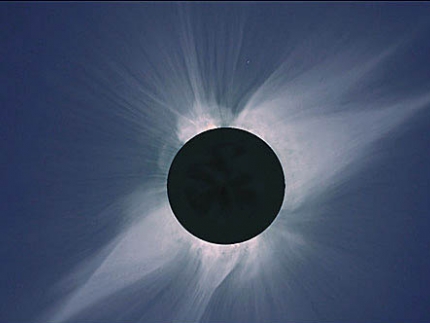
On June 2nd, there will be a solar eclipse that will be able to be seen from parts of the Southern Hemisphere! You can search Time and Date’s path map to see if you’ll be able to view it!
Total solar eclipse. The Sun’s cornea is only visible from Earth during a solar eclipse. Source: NASA
A solar eclipse occurs when the Moon is in between the Sun and the Earth. The Moon’s orbit is tilted around the Earth, so every new moon doesn’t produce an eclipse. Totality (when the Moon completely covers the Sun) will occur at 19:22:57 UTC.
June 3rd: New Moon
New month, new moon! New moon is the first phase of the Moon. When the Moon is in its new moon phase, it can’t be seen very well. In addition, we will experience a spring tide, meaning the high tides will be extra high, while the low tides are extra low. The Moon will be near the Sun in the constellation Taurus.
June 10th: First Quarter and Jupiter Closest Approach
First Quarter is when the right half of the Moon is lit up, while the left side is shrouded in darkness. The Moon will be on the western edge of Virgo. First Quarter also brings a neap tide. A neap tide is when the difference between the high and low tides is at a minimum.
Also on June 10th, Jupiter will be as close to Earth as it gets for a while. It will appear bigger and brighter! Furthermore, Jupiter will be directly opposite the Sun. Jupiter will be in between Scorpius and Sagittarius in the eastern sky.
June 16th: Moon and Jupiter Together
On June 16th, a nearly-full Moon and Jupiter will be together in the sky. They will be in between Scorpius and Sagittarius in the eastern sky.
June 17th: Full Moon
The full moon will be right above Sagittarius in the east. A full moon is when the side of the Moon facing us is totally lit by the Sun. The June full moon is known as the Strawberry Moon. They call it the that because June is the start of strawberry season. There will be another spring tide.
June 18th: Moon and Saturn Together
If you look to Sagittarius in the east on June 18th, you will see the Moon and Saturn together in the sky. Saturn will be directly above the bright moon, so it may be difficult to spot.
June 21st: Summer Solstice
June 21st is the Summer Solstice! The summer solstice is the longest day of the year in the Northern Hemisphere, and the shortest in the Southern. This is due to the axial tilt of the Earth.
June 23rd: Moon at Apogee
On June 23rd, the Moon will be at apogee. Apogee is when the moon is farthest from the Earth. The Moon’s orbit is elliptical enough to create a noticeable difference between apogee and perigee (when it’s closest to the Earth). You can see the tiny moon if you look to Aquarius.
Source: Muzamir Mazlan at Telok Kemang Observatory, Port Dickson, Malaysia.
June 25th: Last Quarter
The moon will be in last quarter on June 25th. The last quarter is when the left side of the moon is lit, while the right is completely dark. The last quarter will be in the constellation Pisces. There will be another neap tide.
Saturn’s rings are easily one of the most amazing sights in the solar system. However, most people don’t know much, if anything, about them. First, it’s important to note that Saturn is not the only planet with rings; all four gas giants have them! However, Saturn’s rings are bigger than any other planet’s. They’re big enough that they can be seen with a relatively small telescope from your own backyard!
Discovering the Rings
Galileo was the first to observe Saturn’s rings in 1610. However, he didn’t immediately realize that what he was looking at was rings. He described what he saw as “ears,” and drew a circle with a smaller circle on either side. Two years later, these “ears” disappeared completely from view. Even more confusing was when they reappeared in 1613.
Galileo’s drawing of Saturn. Top from 1610, bottom from 1616. Source: NASA
In 1655, Christiaan Huygens observed Saturn with a newer, more advanced telescope. He was the first to suggest that Galileo’s “ears” may, in fact, be a system of rings around the planet. Around the same time, Robert Hooke observed the rings and noticed shadows upon them. Then, in 1675, Giovanni Domenico Cassini (also known as Jean-Domenico Cassini) discovered a gap in the rings. Over 100 years later, in 1787, Pierre-Simon Laplace proved that a single disk would not be stable as rings, and proposed that the rings were many tiny rings. Then, over 70 years after that, in 1859, James Clerk Maxwell proved that rings had to be made of many tiny particles to be stable. Nearly 40 years later, in 1895, James Keeler of Allegheny Observatory and Aristarkh Belopolsky of Pulkovo Observatory confirmed that Maxwell was correct; the rings are made up of many tiny particles.
A Look at the Rings
There are 7 major rings around Saturn. Closest to the planet is the D ring, followed by the C ring, B ring, A ring, F ring, G ring, and finally, the E ring. The rings were named in the order they were discovered, so, unfortunately, there is nothing intuitive about this naming system. The rings are made of particles of water ice, ranging in size from .4 inches to 39 inches (1 centimeter to 10 meters). All of these bits added together are about half the size of the Earth’s Antarctic ice shelf.
The rings are roughly 180,000 miles (400,000 kilometers) wide but only 30 to 3280 feet (10 to 1000 meters) thick. The rings are so much wider than they are thick that the rings form a disk-like shape. In fact, if you were to make a scale model of Saturn’s rings in which their thickness is that of a sheet of paper, the rings would be 1.7 miles (2.7 kilometers) across.
Source: NASA/JPL-Caltech/Space Science Institute
Evidence suggests that the rings are only 100 million years old. 100 million years ago, dinosaurs were still wandering the Earth! Now, I know this seems old, but on the time scale of the solar system, that’s basically a baby! For reference, the Earth formed 4.5 billion years ago. That means that the rings formed 4.4 billion years after the Earth.
Scientists are not really sure how the rings formed, so there are a couple of different theories. Many of the theories propose that a moon may have been destroyed (whether by Saturn’s gravity or a collision with another object) and the debris formed the rings. Another theory is that the rings are just leftovers from Saturn’s formation that failed to form a moon. Saturn’s E ring, however, is formed in a totally different way. As Saturn’s moon Enceladus orbits the planet, it spews its icy innards into orbit.
Saturn’s rings are largely influenced by its moons. The Keeler Gap, a break in the A ring, is caused by Saturn’s moon Daphnis clearing its path around the planet. Prometheus and Pandora created the F ring, making them shepherd moons. A shepherd moon is a moon whose gravity forces material into a ring, like a shepherd with their sheep. There are other minor rings who have been corralled there by nearby moons.
Disappearing Rings
Every 15 years, Saturn’s rings grow thinner and thinner until finally, they disappear from view! This phenomenon is known as a ring plane crossing. Galileo was the first to observe a ring plane crossing in 1612 when the “ears” of Saturn disappeared. Like the Earth, Saturn and its rings are tilted with the Sun—27 degrees, to be exact. When the Earth and the rings line up just right, the rings are edge on to us. Since the rings are so thin, we can’t see them. The next ring plane crossing is on March 23, 2025, but Saturn will be close to the Sun and therefore difficult to view.
Left: Source: NASA and The Hubble Heritage Team (STScI/AURA)Acknowledgment: R.G. French (Wellesley College), J. Cuzzi (NASA/Ames), L. Dones (SwRI), and J. Lissauer (NASA/Ames). Right: Saturn with two of it’s moons, only visible during a ring plane crossing. Source: Amanda S. Bosh (Lowell Observatory), Andrew S. Rivkin (Univ. of Arizona/LPL), the HST High Speed Photometer Instrument Team (R.C. Bless, PI), and NASA/ESA.
Ring plane crossings are very exciting for astronomers because it gives them an opportunity to view the planet without the giant, bright rings in the way. In addition, many of Saturn’s moons can only be viewed during a ring plane crossing. 13 of Saturn’s moons were discovered during ring plane crossings, while others’ orbits were able to be studied further. Furthermore, scientists can discover more rings during the crossing—that’s how they found the E ring.
One thing that scientists know for sure is that Saturn’s rings used to be bigger than they are now. They know this because the rings fall into Saturn and become what is appropriately called “ring rain.” At the rate at which the rings are decaying, they could disappear as soon as 100 million years from now.
Luckily, 100 million years is plenty of time for us humans, and we have a lot more research to do. The Cassini spacecraft was able to answer some questions for us, but not all. Saturn’s beautiful rings may not last forever—but they’ll last a lifetime. And that, my friends, is enough for me.



 madison brewer