July Sky Spotlight

Astronomy and Physics, Earth, News

2nd – New Moon, Total Solar Eclipse

July will start off as strong as June did! On only the second day of the month, we will have a total solar eclipse. Most of South America will be able to see at least a partial eclipse. Check Time and Date to see if you’re in the path!

3rd – Moon with Mars and Mercury

Astronomers call the sliver after a new moon a young moon. July’s young moon will be hanging out with Mars and Mercury in the constellation Cancer.

4th – Earth at Aphelion

The Earth’s orbit around the Sun is not a perfect circle, it’s an ellipse. This means that at some point, it must be at it’s furthest point from the Sun. That is in July! Aphelion is when a planet is farthest from it’s sun. This won’t affect our life at all, it’s just a neat fact.

9th – First Quarter, Saturn at Opposition

On July 9th, the Moon will be in it’s first quarter phase. This means that the left half will be dark and the right half will be light.

In addition, Saturn will be at opposition. This means that Earth will be directly between Saturn and the Sun.

13th – Moon with Jupiter

Jupiter and the Moon will be together in the constellation Scorpius in the Southern sky.

15th – Moon with Saturn

Saturn will be just East of the nearly full moon. They will be together in the constellation Sagittarius in the Southern Sky.

16th – Full Moon, Partial Lunar Eclipse

Most of the world (not including North America) will be able to see the Partial Lunar Eclipse! Check Time and Date to see if you’re in the path. If, like me, you are not in the path, enjoy the bright, beautiful full moon.

20th – Moon with Neptune

The Moon will be with Neptune in the constellation Aquarius in the Eastern night sky.

24th – Last Quarter, Moon and Uranus

On the 24th, the Moon will be in it’s last quarter with Uranus. They will be in Aries.

28th – Southern Delta Aquariid Meteor Shower Peaks

From midnight to dawn, and especially at 2 a.m., we will be able to see meteors originating from Aquarius. The moon will be a dark crescent, so the meteors will be easier to see. It is more visible from the Southern hemisphere than from the Northern Hemisphere.

31st – New Moon

Finally, on the last day of the month, we will end the same way we began: with a new moon.

Happy July viewing!

June Sky Spotlight

Astronomy and Physics, Earth, News

June is finally here! There’s a lot of exciting sights in the sky this month. Unfortunately, Mars and Venus will not be in their best viewing location; both planets rise in the morning and set in the afternoon and evening. Luckily, however, Jupiter and Saturn will be quite visible! These planets will rise in the evening and set in the morning.

June 2nd: Solar Eclipse

On June 2nd, there will be a solar eclipse that will be able to be seen from parts of the Southern Hemisphere! You can search Time and Date’s path map to see if you’ll be able to view it!

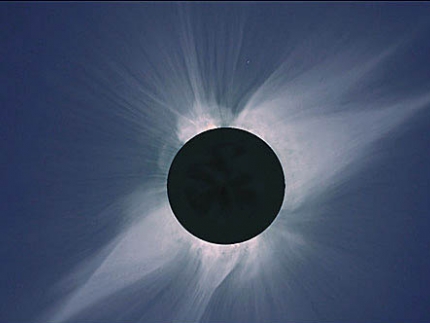
Total solar eclipse. The Sun’s cornea is only visible from Earth during a solar eclipse. Source: NASA

A solar eclipse occurs when the Moon is in between the Sun and the Earth. The Moon’s orbit is tilted around the Earth, so every new moon doesn’t produce an eclipse. Totality (when the Moon completely covers the Sun) will occur at 19:22:57 UTC.

June 3rd: New Moon

New month, new moon! New moon is the first phase of the Moon. When the Moon is in its new moon phase, it can’t be seen very well. In addition, we will experience a spring tide, meaning the high tides will be extra high, while the low tides are extra low. The Moon will be near the Sun in the constellation Taurus.

June 10th: First Quarter and Jupiter Closest Approach

First Quarter is when the right half of the Moon is lit up, while the left side is shrouded in darkness. The Moon will be on the western edge of Virgo. First Quarter also brings a neap tide. A neap tide is when the difference between the high and low tides is at a minimum.

Also on June 10th, Jupiter will be as close to Earth as it gets for a while. It will appear bigger and brighter! Furthermore, Jupiter will be directly opposite the Sun. Jupiter will be in between Scorpius and Sagittarius in the eastern sky.

June 16th: Moon and Jupiter Together

On June 16th, a nearly-full Moon and Jupiter will be together in the sky. They will be in between Scorpius and Sagittarius in the eastern sky.

June 17th: Full Moon

The full moon will be right above Sagittarius in the east. A full moon is when the side of the Moon facing us is totally lit by the Sun. The June full moon is known as the Strawberry Moon. They call it the that because June is the start of strawberry season. There will be another spring tide.

June 18th: Moon and Saturn Together

If you look to Sagittarius in the east on June 18th, you will see the Moon and Saturn together in the sky. Saturn will be directly above the bright moon, so it may be difficult to spot.

June 21st: Summer Solstice

June 21st is the Summer Solstice! The summer solstice is the longest day of the year in the Northern Hemisphere, and the shortest in the Southern. This is due to the axial tilt of the Earth.

June 23rd: Moon at Apogee

On June 23rd, the Moon will be at apogee. Apogee is when the moon is farthest from the Earth. The Moon’s orbit is elliptical enough to create a noticeable difference between apogee and perigee (when it’s closest to the Earth). You can see the tiny moon if you look to Aquarius.

Source: Muzamir Mazlan at Telok Kemang Observatory, Port Dickson, Malaysia.

June 25th: Last Quarter

The moon will be in last quarter on June 25th. The last quarter is when the left side of the moon is lit, while the right is completely dark. The last quarter will be in the constellation Pisces. There will be another neap tide.