August Sky Spotlight

Astronomy and Physics, Earth, News

2nd: Moon at Perigee

On August 2nd, the Moon will be at its closest spot to Earth. This is called perigee.

7th: 1st Quarter

The Moon will be in its first quarter phase!

9th: Moon and Jupiter; Mercury in Greatest Western Elongation

The Moon and Jupiter will meet in the constellation Scorpio in the Southwestern sky.

Saturn, Venus, and Mercury in a dawning sky. Source: universetoday.com

Since Mercury is in between the Earth and the Sun, Mercury is always in the daytime sky. As Mercury goes around the Sun, it gets closer and farther away from the Sun in the sky. On the 9th, Mercury will be as far from the Sun as it gets. This is called greatest western elongation. This is when Mercury is at its best viewing because it’s not washed out by the Sun.

11th: Venus and Sun

On the 11th, Venus and the Sun will be together in the constellation Cancer! However, the Sun’s brightness will make this nearly impossible to view. Look towards (but not at) the rising Sun in the East.

12th: Moon, Saturn, and Pluto; Perseid’s Peak

The Moon, Saturn, and Pluto will be together in Sagittarius on the 12th. To see them, look towards the Southern sky.

In addition to seeing the Moon and planets, this night will feature one of the best shows the sky puts on: a meteor shower. The Perseid Meteor Shower will peak the night of the 12th and into the morning of the 13th. Look to the Northeast to see the show. Unfortunately, the bright Moon will inhibit viewing, but there will still be plenty to see!

15th: Full Moon, Venus at its Brightest 

The 15th will bring a full moon! And, if you look at the dawn sky, you will see a very bright Venus.

17th: Moon and Neptune; Moon at Apogee

The Moon and Neptune will appear together on the Eastern side of Aquarius. In addition, the Moon will be at apogee, it’s farthest point from Earth.

21st: Uranus and Moon

On the 21st, Uranus and the Moon will be seen in the Eastern sky in Aries.

23rd: Last Quarter; Venus and Mars

The Moon will be in its last quarter phase on the 23rd, while Venus and Mars will be together in the sky. They will be near the Sun in the constellation Leo.

29th: Mercury, Moon, and Sun

On the 29th, Mercury, the Moon, and the Sun will all be together. Look to the dawn sky to see them.

30th: Moon, Venus, and Mars; New Moon; Moon at Perigee 

The Moon, Venus, and Mars will be near the Sun; dawn will bring the best viewing. However, the new moon may be difficult to spot. Finally, the Moon will have returned to its closest point to the Earth.

31st: Sun and Mars

The Sun and Mars will be together in the constellation Leo.


Dyson Spheres: Smart or Stupid?

Astronomy and Physics, Earth, News

The other day my dad made a bold claim: Dyson spheres are stupid. I told him that they were not stupid, and he replied that they are because they’re physically impossible. 

I have to admit, he may have a point there. I mean, a true Dyson sphere would have to be quite large. That would take a lot of materials. Does the Earth have enough materials? Does the solar system? 

A Dyson sphere is a theoretical structure that encompasses a star. This structure would harvest as much sunlight as possible.

Olaf Stapledon made the first mention of Dyson spheres in his book Star Maker, but Freedman Dyson later proposed them in a scientific journal as a solution to an advanced civilization’s energy shortage. We rank hypothetical advanced civilizations on the Kardashev Scale, which is based on energy consumption. Currently, humans are not advanced enough to show up on the scale. However, a civilization with a Dyson sphere would be a Type II civilization—they would be able to harness the energy of their star. 

The sun is constantly producing 386 septillion watts of energy. Less than a billionth of a percent of this energy reaches the Earth. Humans harvest even less than this. Clearly, there is a ton of missed solar energy. 

But how would a Dyson sphere actually work? If it were to encompass the sun, but not the Earth, we would no longer receive sunlight. That wouldn’t work; it’s common knowledge that we need sunlight for life. So maybe it should follow the Earth’s orbit, with a little gap for the Earth. Or maybe it should be a little bigger than the Earth’s orbit and hold us inside too. Either way, that would be an astronomically large structure. The Earth is 93 million miles from the sun, so a sphere of that size would have a surface area of 109 quadrillion miles squared. My dad is right, that would be (nearly) impossible. There are not enough materials on the Earth. Luckily, there are enough materials in the solar system to build one. However, I wouldn’t count on it. 

An artist’s concept of a Dyson sphere. Source: CapnHack, via energyphysics.wikispaces.com

Okay, so we can’t have a Dyson sphere. But maybe we can have a Dyson part of a sphere? Or a Dyson fleet of satellites? Some (my dad), may argue that this is not a true Dyson sphere, but we could harvest far more energy than we do now. Right now, humans can only dream of a Dyson sphere. We don’t have the technology to build such a thing. Even a simpler version would be way out of our league. An array of satellites would need carefully calculated orbits. However, some of these orbits would probably overlap, thus blocking the very light they were sent to collect. 

While a Dyson sphere would be really cool, we don’t need to go to space to harvest light for energy. I mean, we have plenty of working solar panels on Earth. Plus, they’re becoming more popular; solar energy has been increasing for years and continues to do so. While solar energy isn’t as efficient at producing energy as fossil fuels are, you don’t have to pay for sunlight. 

Maybe Dyson spheres are in our future—not our near future, of course. I, for one, don’t have a lot of hope. I think they’re a cool theoretical structure, but I believe they will remain exactly that: theoretical. I would also like to say that my dad is not right. Dyson spheres are not dumb. We just have to be smart enough to build them.


Nancy Grace Roman: the Mother of Hubble

Astronomy and Physics, Earth, News, women in science

Dr. Nancy Grace Roman was interested in astronomy from the very beginning. Born in Tenessee in 1925, in elementary school Roman was a co-founder of an astronomy club. She went on to excel in a Baltimore high school and attended Swarthmore College to earn her bachelors degree in Astronomy. In 1949, she received her doctorate in astronomy from the University of Chicago.

Dr. Roman in 1962. Credit: NASA

Shortly after earning her Ph.D., Dr. Roman found a star with unusual emission spectra. This discovery helped her create a name for herself among astronomers.

She began her work teaching at the University of Chicago but left because she didn’t see a future for herself there. She believed that she would never receive tenure simply because she was a woman.

I’m happy about the fact that women can get senior jobs now. They’re not being quite as discouraged as I was.

Nancy Grace Roman

In 1959, Dr. Roman became NASA’s first chief of astronomy. She traveled across the country, speaking to astronomers and giving lectures. She spoke of the advantage of observing the stars from outer space: no light pollution, no clouds, and no atmosphere to block parts of the signal. Most importantly, however, she spoke about and lobbied for the Hubble Space Telescope.

Dr. Roman spoke to secure funding for the project. She pushed for designs to be drawn. Her work has earned her the title “the Mother of Hubble.” And yet, very few people have heard of her.

It wouldn’t be until 1990, after her retirement, that she would see her efforts launched into orbit. 

Nancy Grace Roman, later in life. Source: NASA

Dr. Nancy Grace Roman died in 2018 at the age of 93. A fantastic scientist, inspirational woman, and passionate person, her legacy lives on in our beloved Hubble Space Telescope.

Dr. Roman did everything she could to help the Hubble Space Telescope project. Who knows where it would have gone without her? But Dr. Roman is largely forgotten. Time is washing her memory into oblivion. We must keep Dr. Roman and every other influential woman in history alive. I, among others, must write about her. You must talk about her. We must remember her.


To read about more women in science, check out the links below:


July Sky Spotlight

Astronomy and Physics, Earth, News

2nd – New Moon, Total Solar Eclipse

July will start off as strong as June did! On only the second day of the month, we will have a total solar eclipse. Most of South America will be able to see at least a partial eclipse. Check Time and Date to see if you’re in the path!

3rd – Moon with Mars and Mercury

Astronomers call the sliver after a new moon a young moon. July’s young moon will be hanging out with Mars and Mercury in the constellation Cancer.

4th – Earth at Aphelion

The Earth’s orbit around the Sun is not a perfect circle, it’s an ellipse. This means that at some point, it must be at it’s furthest point from the Sun. That is in July! Aphelion is when a planet is farthest from it’s sun. This won’t affect our life at all, it’s just a neat fact.

9th – First Quarter, Saturn at Opposition

On July 9th, the Moon will be in it’s first quarter phase. This means that the left half will be dark and the right half will be light.

In addition, Saturn will be at opposition. This means that Earth will be directly between Saturn and the Sun.

13th – Moon with Jupiter

Jupiter and the Moon will be together in the constellation Scorpius in the Southern sky.

15th – Moon with Saturn

Saturn will be just East of the nearly full moon. They will be together in the constellation Sagittarius in the Southern Sky.

16th – Full Moon, Partial Lunar Eclipse

Most of the world (not including North America) will be able to see the Partial Lunar Eclipse! Check Time and Date to see if you’re in the path. If, like me, you are not in the path, enjoy the bright, beautiful full moon.

20th – Moon with Neptune

The Moon will be with Neptune in the constellation Aquarius in the Eastern night sky.

24th – Last Quarter, Moon and Uranus

On the 24th, the Moon will be in it’s last quarter with Uranus. They will be in Aries.

28th – Southern Delta Aquariid Meteor Shower Peaks

From midnight to dawn, and especially at 2 a.m., we will be able to see meteors originating from Aquarius. The moon will be a dark crescent, so the meteors will be easier to see. It is more visible from the Southern hemisphere than from the Northern Hemisphere.

31st – New Moon

Finally, on the last day of the month, we will end the same way we began: with a new moon.

Happy July viewing!


Seeing Distant Planets

Astronomy and Physics, Beyond, News

As always, the Hubble Space Telescope is looking to the stars for new exciting sights. Images of swirling galaxies are extremely common. On June 3, 2019, the Hubble Space Telescope released this photo of two exoplanets orbiting a distant star―an incredibly uncommon sight.

The system is called PDS 70 and is located in the constellation Centaurus. Less massive but larger than our sun, the star, also called V1032 Centauri, is a K5 type. K5 stars are cooler and dimmer than our sun. PDS 70 is 370 light-years from the Earth. That’s over 2.17 quadrillion (2,170,000,000,000,000) miles (3.5 quadrillion kilometers)!

In the image below, the white star represents the location of V1032 Centauri. To the left is PDS 70 b and to the right is PDS 70 c.

Exoplanets PDS 70 b and c. Source: ESO and S. Haffert (Leiden Observatory)

Right now, the only way astronomers know how to find planets is by observing the light from the stars. If there is a regular periodic dip in the signal, astronomers can infer that something is passing in front of it. Anything large enough to do this is probably a planet. While this is helpful, a measurement taken from this far leaves lots of room for error.

These planets were first imaged using the Very Large Telescope in Chile. We know that PDS 70 b is 4 to 17 times as massive as Jupiter, while PDS 70 c is 1 to 10 times as massive. The large range in these estimates is a consequence of the lack of precision in the measurement.

Astronomers are rarely able to get images like this because the stars are so big and bright and the planets are small and dim. Star light completely conceals anything coming from a distant planet. In the image above, astronomers cancelled light from the star to reveal the planets.

Once again, the Hubble Space Telescope dazzles us with the cosmos. We will have to wait to see what new sights they excite us with next time!

June Sky Spotlight

Astronomy and Physics, Earth, News

June is finally here! There’s a lot of exciting sights in the sky this month. Unfortunately, Mars and Venus will not be in their best viewing location; both planets rise in the morning and set in the afternoon and evening. Luckily, however, Jupiter and Saturn will be quite visible! These planets will rise in the evening and set in the morning.

June 2nd: Solar Eclipse

On June 2nd, there will be a solar eclipse that will be able to be seen from parts of the Southern Hemisphere! You can search Time and Date’s path map to see if you’ll be able to view it!

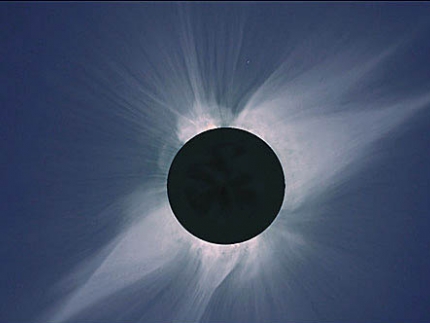
Total solar eclipse. The Sun’s cornea is only visible from Earth during a solar eclipse. Source: NASA

A solar eclipse occurs when the Moon is in between the Sun and the Earth. The Moon’s orbit is tilted around the Earth, so every new moon doesn’t produce an eclipse. Totality (when the Moon completely covers the Sun) will occur at 19:22:57 UTC.

June 3rd: New Moon

New month, new moon! New moon is the first phase of the Moon. When the Moon is in its new moon phase, it can’t be seen very well. In addition, we will experience a spring tide, meaning the high tides will be extra high, while the low tides are extra low. The Moon will be near the Sun in the constellation Taurus.

June 10th: First Quarter and Jupiter Closest Approach

First Quarter is when the right half of the Moon is lit up, while the left side is shrouded in darkness. The Moon will be on the western edge of Virgo. First Quarter also brings a neap tide. A neap tide is when the difference between the high and low tides is at a minimum.

Also on June 10th, Jupiter will be as close to Earth as it gets for a while. It will appear bigger and brighter! Furthermore, Jupiter will be directly opposite the Sun. Jupiter will be in between Scorpius and Sagittarius in the eastern sky.

June 16th: Moon and Jupiter Together

On June 16th, a nearly-full Moon and Jupiter will be together in the sky. They will be in between Scorpius and Sagittarius in the eastern sky.

June 17th: Full Moon

The full moon will be right above Sagittarius in the east. A full moon is when the side of the Moon facing us is totally lit by the Sun. The June full moon is known as the Strawberry Moon. They call it the that because June is the start of strawberry season. There will be another spring tide.

June 18th: Moon and Saturn Together

If you look to Sagittarius in the east on June 18th, you will see the Moon and Saturn together in the sky. Saturn will be directly above the bright moon, so it may be difficult to spot.

June 21st: Summer Solstice

June 21st is the Summer Solstice! The summer solstice is the longest day of the year in the Northern Hemisphere, and the shortest in the Southern. This is due to the axial tilt of the Earth.

June 23rd: Moon at Apogee

On June 23rd, the Moon will be at apogee. Apogee is when the moon is farthest from the Earth. The Moon’s orbit is elliptical enough to create a noticeable difference between apogee and perigee (when it’s closest to the Earth). You can see the tiny moon if you look to Aquarius.

Source: Muzamir Mazlan at Telok Kemang Observatory, Port Dickson, Malaysia.

June 25th: Last Quarter

The moon will be in last quarter on June 25th. The last quarter is when the left side of the moon is lit, while the right is completely dark. The last quarter will be in the constellation Pisces. There will be another neap tide.


Another Galaxy Coming to Space Near You!

Astronomy and Physics, Beyond, News

Space continues to dazzle the eye! NASA recently posted this photo of Messier 90. Messier 90, also called NGC 4569, is a spiral galaxy located in the constellation Virgo about 90 million light years away from the Earth.

This image is a composite of light from the infrared, visible, and ultraviolet parts of the spectrum. The black portion of the photo is just a consequence of the camera used.

Source: ESA/Hubble & NASA, W. Sargent et al.

The most fascinating thing about Messier 90 is that the galaxy is moving towards us.

Most galaxies are moving away from us, with a few notable exceptions, including the Andromeda Galaxy. The galaxies move away because the universe is expanding. On a larger scale, everything moves away from us. However, on a more local scale, this expansion isn’t as intense, so galaxies are able to move towards one another.

Astronomers know Messier 90 is moving towards us because it is blue-shifted. The stars that make up galaxies produce photons, the particles of light, in every wavelength of the electromagnetic spectrum. When photons interact with atoms, such as the hydrogen and helium in stars, certain wavelengths are “blacked out” from the spectrum in what are called absorption lines. Absorption lines always occur at the same wavelength for each specific element. Therefore, scientists know exactly where the lines should be. Furthermore, they know exactly which elements a star contains based on these lines alone.

As a source moves towards the observer, the light waves are compressed, making them appear shorter. This causes the absorption lines to move to the shorter wavelength part of the spectrum, or towards the blue part of the visible spectrum. This is why we call them blue-shifted.

The same thing happens when galaxies move away, but instead, the wavelengths get longer. We call this red-shifted. In fact, the large number of red-shifted galaxies is how Edwin Hubble discovered the universe is expanding!

Messier 90 is a member of the Virgo Cluster, a neighbor of our own Local Group. The Virgo Cluster is another small cluster in our supercluster. The Virgo Cluster is thought to be whipping member galaxies around, causing some to be heading towards us. Astronomers think this because Messier 90 is not the only blue-shifted galaxy in the Virgo Cluster. Messier 86 is also blue-shifted!

Messier 90’s center has lots of active star formation, but this does not extend to the edges of the galaxy. Astronomers believe that this is another consequence of the galaxy’s membership in the Virgo Cluster. They theorize that other galaxies in the cluster have stripped Messier 90 of its interstellar material, quenching star formation. In addition, scientists believe that supernovae in the center of the galaxy blew star-forming material out of the galaxy.

How to Send Your Name to the Red Planet

Astronomy and Physics, News, solar system

Almost every child has dreamed of being an astronaut. We look up at the stars and wonder what’s up there. While not everyone will be an astronaut, there are other ways to get your name to space.

NASA has announced a public engagement campaign in which anyone can submit their name to be sent to Mars. The names will be etched onto a chip and sent with NASA’s Mars 2020 rover. The names will be written “smaller than one-thousandth the width of a human hair”, according to NASA.

So far, over 4 million names have been submitted. A single chip can hold over a million names, but I think it’s safe to assume that NASA will be sending more than one chip with the rover.

Everyone who submits their name will receive a “boarding pass” for a flight to Mars. This boarding pass is, of course, for fun, and not a ticket to the Red Planet. It also “awards” frequent flyer points.

Anyone who wants to submit their name has until the end of September to do so. To submit your name, click here.

The rover will launch in July/August 2020 because Mars and the Earth will be close to each other. When they’re closer together, it takes less fuel, time, and money to launch. Therefore, these “close approaches” are simply the best time to launch.

Artist concept of the Mars 2020 rover. Source: NASA/JPL-CalTech

This rover’s main research will be regarding potential life on Mars. The rover will drill into the Martian surface to collect rock and dirt samples. These samples will be set aside, potentially to be brought to Earth in the future. In addition, the rover will look for organic compounds in the rocks. Other functions include testing an oxygen-production method and looking for subsurface water.

NASA’s Mars 2020 rover is going to allow us to understand the Red Planet’s history as well as we understand the Earth’s. In addition, scientists are hoping to answer questions about the possibilities of humans residing on Mars. That goal, however, is a long way away. NASA has recently announced plans to land humans on the Moon by 2024. This is a huge step towards Mars, but the Moon is considerably closer than Mars. Right now, the plan is to land humans on Mars in the 2030s.

Slowly but surely, humanity is going to Mars. It’ll be an exciting thing to watch. Click here for more information on Mars 2020.

Illu-moon-ating Research

Astronomy and Physics, Earth, News

In 2020, NASA will be launching the Space Launch System’s first Exploration Mission. On board will be yeast (to study radiation in space), a solar sail (that will study a near-Earth asteroid), and something called Lunar Flashlight.

Many craters on the Moon are constantly shrouded in shadows. This is a huge problem because light is the only thing we receive from space that we can study (besides meteorites and, of course, going there). Since we don’t receive light from these craters, we have absolutely no idea what’s down there.

That’s exactly what Lunar Flashlight hopes to illuminate.

In the past, the only way to study shadowed craters was to slam something into them and study the debris that flies up. This method allowed scientists to study only one location at a time. Now, the whole Moon can be observed from orbit. Lunar Flashlight will use a solar sail to reflect light into these dark craters. Then, scientists will study the light reflected back and make a map of where the water ice is located.

Artist concept of Lunar Flashlight. Source: NASA/JPL-CalTech

We’ve known about water on the Moon since 2009 when NASA’s LCROSS probe slammed into the Moon’s south pole. Then, in 2017, researhers from Brown University made a map of water on the Moon. However, they acknowledge “that only a small fraction of the Moon has been directly sampled.” Lunar Flashlight hopes to fill in those gaps.

When we go back to the Moon, we want to do so in a strategic location. According to NASA, “resources at destinations in space, such as atmospheres, water ice and regolith, can be broken down into their component molecules and used as building materials, propellant, oxygen for humans to breathe and drinking water.”

Locations with more of these resources are therefore more valuable than those without. NASA hopes to find more of these locations in places that we have been unable to study. In the future, they may be used as a landing spot or the home of a Lunar base.

Nearly 50 years ago, NASA only dreamed of going to the Moon. Now, we are planning a Lunar base to take us beyond our tiny portion of the solar system. Lunar Flashlight is just the beginning.