August Sky Spotlight

Astronomy and Physics, Earth, News

2nd: Moon at Perigee

On August 2nd, the Moon will be at its closest spot to Earth. This is called perigee.

7th: 1st Quarter

The Moon will be in its first quarter phase!

9th: Moon and Jupiter; Mercury in Greatest Western Elongation

The Moon and Jupiter will meet in the constellation Scorpio in the Southwestern sky.

Saturn, Venus, and Mercury in a dawning sky. Source: universetoday.com

Since Mercury is in between the Earth and the Sun, Mercury is always in the daytime sky. As Mercury goes around the Sun, it gets closer and farther away from the Sun in the sky. On the 9th, Mercury will be as far from the Sun as it gets. This is called greatest western elongation. This is when Mercury is at its best viewing because it’s not washed out by the Sun.

11th: Venus and Sun

On the 11th, Venus and the Sun will be together in the constellation Cancer! However, the Sun’s brightness will make this nearly impossible to view. Look towards (but not at) the rising Sun in the East.

12th: Moon, Saturn, and Pluto; Perseid’s Peak

The Moon, Saturn, and Pluto will be together in Sagittarius on the 12th. To see them, look towards the Southern sky.

In addition to seeing the Moon and planets, this night will feature one of the best shows the sky puts on: a meteor shower. The Perseid Meteor Shower will peak the night of the 12th and into the morning of the 13th. Look to the Northeast to see the show. Unfortunately, the bright Moon will inhibit viewing, but there will still be plenty to see!

15th: Full Moon, Venus at its Brightest 

The 15th will bring a full moon! And, if you look at the dawn sky, you will see a very bright Venus.

17th: Moon and Neptune; Moon at Apogee

The Moon and Neptune will appear together on the Eastern side of Aquarius. In addition, the Moon will be at apogee, it’s farthest point from Earth.

21st: Uranus and Moon

On the 21st, Uranus and the Moon will be seen in the Eastern sky in Aries.

23rd: Last Quarter; Venus and Mars

The Moon will be in its last quarter phase on the 23rd, while Venus and Mars will be together in the sky. They will be near the Sun in the constellation Leo.

29th: Mercury, Moon, and Sun

On the 29th, Mercury, the Moon, and the Sun will all be together. Look to the dawn sky to see them.

30th: Moon, Venus, and Mars; New Moon; Moon at Perigee 

The Moon, Venus, and Mars will be near the Sun; dawn will bring the best viewing. However, the new moon may be difficult to spot. Finally, the Moon will have returned to its closest point to the Earth.

31st: Sun and Mars

The Sun and Mars will be together in the constellation Leo.


Dyson Spheres: Smart or Stupid?

Astronomy and Physics, Earth, News

The other day my dad made a bold claim: Dyson spheres are stupid. I told him that they were not stupid, and he replied that they are because they’re physically impossible. 

I have to admit, he may have a point there. I mean, a true Dyson sphere would have to be quite large. That would take a lot of materials. Does the Earth have enough materials? Does the solar system? 

A Dyson sphere is a theoretical structure that encompasses a star. This structure would harvest as much sunlight as possible.

Olaf Stapledon made the first mention of Dyson spheres in his book Star Maker, but Freedman Dyson later proposed them in a scientific journal as a solution to an advanced civilization’s energy shortage. We rank hypothetical advanced civilizations on the Kardashev Scale, which is based on energy consumption. Currently, humans are not advanced enough to show up on the scale. However, a civilization with a Dyson sphere would be a Type II civilization—they would be able to harness the energy of their star. 

The sun is constantly producing 386 septillion watts of energy. Less than a billionth of a percent of this energy reaches the Earth. Humans harvest even less than this. Clearly, there is a ton of missed solar energy. 

But how would a Dyson sphere actually work? If it were to encompass the sun, but not the Earth, we would no longer receive sunlight. That wouldn’t work; it’s common knowledge that we need sunlight for life. So maybe it should follow the Earth’s orbit, with a little gap for the Earth. Or maybe it should be a little bigger than the Earth’s orbit and hold us inside too. Either way, that would be an astronomically large structure. The Earth is 93 million miles from the sun, so a sphere of that size would have a surface area of 109 quadrillion miles squared. My dad is right, that would be (nearly) impossible. There are not enough materials on the Earth. Luckily, there are enough materials in the solar system to build one. However, I wouldn’t count on it. 

An artist’s concept of a Dyson sphere. Source: CapnHack, via energyphysics.wikispaces.com

Okay, so we can’t have a Dyson sphere. But maybe we can have a Dyson part of a sphere? Or a Dyson fleet of satellites? Some (my dad), may argue that this is not a true Dyson sphere, but we could harvest far more energy than we do now. Right now, humans can only dream of a Dyson sphere. We don’t have the technology to build such a thing. Even a simpler version would be way out of our league. An array of satellites would need carefully calculated orbits. However, some of these orbits would probably overlap, thus blocking the very light they were sent to collect. 

While a Dyson sphere would be really cool, we don’t need to go to space to harvest light for energy. I mean, we have plenty of working solar panels on Earth. Plus, they’re becoming more popular; solar energy has been increasing for years and continues to do so. While solar energy isn’t as efficient at producing energy as fossil fuels are, you don’t have to pay for sunlight. 

Maybe Dyson spheres are in our future—not our near future, of course. I, for one, don’t have a lot of hope. I think they’re a cool theoretical structure, but I believe they will remain exactly that: theoretical. I would also like to say that my dad is not right. Dyson spheres are not dumb. We just have to be smart enough to build them.


June Sky Spotlight

Astronomy and Physics, Earth, News

June is finally here! There’s a lot of exciting sights in the sky this month. Unfortunately, Mars and Venus will not be in their best viewing location; both planets rise in the morning and set in the afternoon and evening. Luckily, however, Jupiter and Saturn will be quite visible! These planets will rise in the evening and set in the morning.

June 2nd: Solar Eclipse

On June 2nd, there will be a solar eclipse that will be able to be seen from parts of the Southern Hemisphere! You can search Time and Date’s path map to see if you’ll be able to view it!

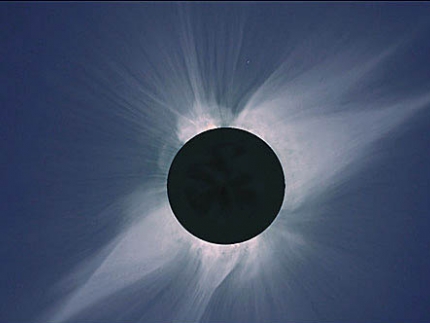
Total solar eclipse. The Sun’s cornea is only visible from Earth during a solar eclipse. Source: NASA

A solar eclipse occurs when the Moon is in between the Sun and the Earth. The Moon’s orbit is tilted around the Earth, so every new moon doesn’t produce an eclipse. Totality (when the Moon completely covers the Sun) will occur at 19:22:57 UTC.

June 3rd: New Moon

New month, new moon! New moon is the first phase of the Moon. When the Moon is in its new moon phase, it can’t be seen very well. In addition, we will experience a spring tide, meaning the high tides will be extra high, while the low tides are extra low. The Moon will be near the Sun in the constellation Taurus.

June 10th: First Quarter and Jupiter Closest Approach

First Quarter is when the right half of the Moon is lit up, while the left side is shrouded in darkness. The Moon will be on the western edge of Virgo. First Quarter also brings a neap tide. A neap tide is when the difference between the high and low tides is at a minimum.

Also on June 10th, Jupiter will be as close to Earth as it gets for a while. It will appear bigger and brighter! Furthermore, Jupiter will be directly opposite the Sun. Jupiter will be in between Scorpius and Sagittarius in the eastern sky.

June 16th: Moon and Jupiter Together

On June 16th, a nearly-full Moon and Jupiter will be together in the sky. They will be in between Scorpius and Sagittarius in the eastern sky.

June 17th: Full Moon

The full moon will be right above Sagittarius in the east. A full moon is when the side of the Moon facing us is totally lit by the Sun. The June full moon is known as the Strawberry Moon. They call it the that because June is the start of strawberry season. There will be another spring tide.

June 18th: Moon and Saturn Together

If you look to Sagittarius in the east on June 18th, you will see the Moon and Saturn together in the sky. Saturn will be directly above the bright moon, so it may be difficult to spot.

June 21st: Summer Solstice

June 21st is the Summer Solstice! The summer solstice is the longest day of the year in the Northern Hemisphere, and the shortest in the Southern. This is due to the axial tilt of the Earth.

June 23rd: Moon at Apogee

On June 23rd, the Moon will be at apogee. Apogee is when the moon is farthest from the Earth. The Moon’s orbit is elliptical enough to create a noticeable difference between apogee and perigee (when it’s closest to the Earth). You can see the tiny moon if you look to Aquarius.

Source: Muzamir Mazlan at Telok Kemang Observatory, Port Dickson, Malaysia.

June 25th: Last Quarter

The moon will be in last quarter on June 25th. The last quarter is when the left side of the moon is lit, while the right is completely dark. The last quarter will be in the constellation Pisces. There will be another neap tide.